
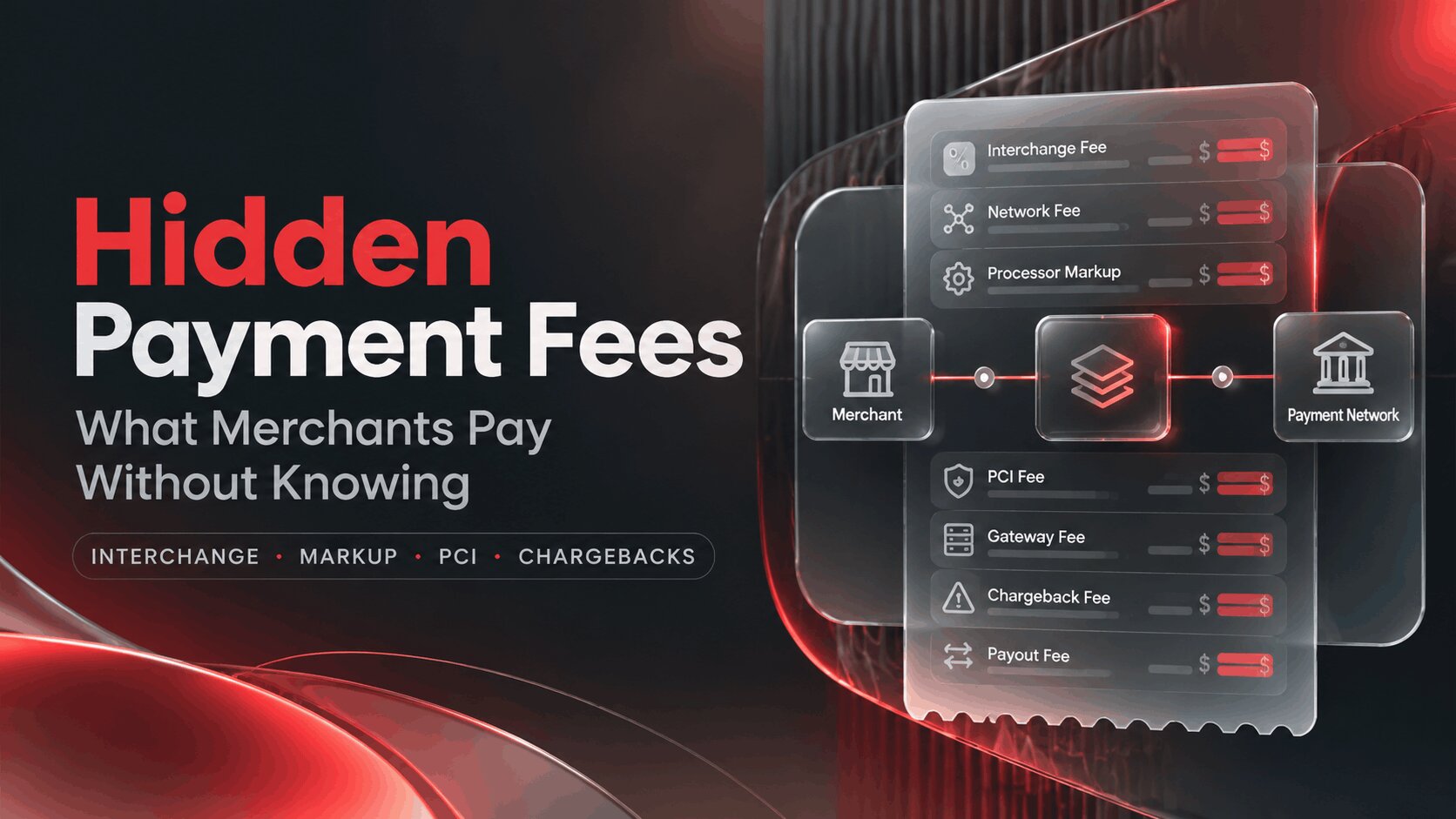
How do I avoid hidden payment processing fees as a merchant?
Ask for interchange-plus pricing, get a complete written fee schedule before you sign, and check every monthly statement against it. Most “hidden” fees are either a processor markup buried inside a flat or tiered rate, or add-on charges (PCI, monthly minimums, gateway, chargeback and payout fees) that you can often negotiate away or avoid. Your all-in cost, called the effective rate, is total fees divided by total card sales. If it creeps up and you can’t explain why, something is hiding.
Thank you for reading this post, don't forget to subscribe!
Card processing typically costs a business 1.5% to 3.5% of each sale, according to NerdWallet. Here is where that money goes, fee by fee.

The fees, one by one
1. Interchange fees
What it is: The fee the card-issuing bank collects on every card sale. It is the biggest piece of your cost, and nobody can negotiate it away, including your processor.
Typical range: Visa’s published U.S. rates (effective April 18, 2026) run from 0.05% + $0.21 for regulated debit cards to 2.30% + $0.10 for premium Visa Infinite credit cards in person. Online, standard Visa credit is 1.89% + $0.10 and premium cards go up to 2.60% + $0.10. Transactions that don’t meet Visa’s data requirements can drop to the “non-qualified” rate of 3.15% + $0.10.
How it hides: On flat-rate pricing you never see interchange at all. You pay the same rate on a cheap debit card as on a premium rewards card, and the processor keeps the difference.
How to reduce it: You can’t negotiate the rates, but you can make sure your sales qualify for the lowest ones. Use chip or tap instead of keying in card numbers, send address verification and full transaction data, and settle (batch) your sales every day.
2. Network (assessment) fees
What it is: A small fee the card networks charge on all of your volume.
Typical range: About 0.14% of Visa credit volume and 0.13% of Visa debit volume. Mastercard is about 0.13%, plus small per-transaction fees of a few cents.
How it hides: Some processors label their own markup as a “card brand fee” or “network fee,” or charge more than the published rate.
How to reduce it: The real network fees can’t be avoided, but they can be checked. Multiply your Visa credit volume by 0.14%. If the “assessment” line on your statement is noticeably higher, ask your processor why.
3. Processor markup
What it is: What your processor actually earns. This is the part you can negotiate.
Typical range: Helcim publishes interchange-plus margins from 0.40% + 8¢ in person and 0.50% + 25¢ online for small merchants, falling to 0.15% + 6¢ at higher volume. Flat-rate providers build their markup into one number, such as Stripe’s 2.9% + 30¢ online and 2.7% + 5¢ in person, or Square’s 2.6% + 15¢ in person.
How it hides: In flat-rate and “tiered” pricing (qualified, mid-qualified and non-qualified buckets), the markup is mixed in with interchange, so you can’t see how much it is.
How to reduce it: Ask for interchange-plus pricing, where interchange and network fees are passed through at cost and the markup is listed separately. Then compare markups between processors.
4. Chargeback fees
What it is: A fee charged when a customer disputes a payment. You pay it on top of losing the sale amount.
Typical range: NerdWallet puts it at $20 to $100 per dispute. Stripe charges $15 per dispute received, plus another $15 if you contest it (refunded if you win). Square does not charge a chargeback fee.
How it hides: It’s charged one dispute at a time, so it rarely appears in a rate quote. A high dispute rate can also push your processor to raise your rates or hold back reserves.
How to reduce it: Use a billing descriptor customers will recognize, send receipts, make refunds easy, and keep proof of delivery and authorization. For bank payments, see our guide to ACH payment disputes (https://www.monarch.is/understanding-ach-payment-disputes-how-businesses-can-protect-themselves/).
5. Gateway fees
What it is: The fee for the software that sends online payments to your processor.
Typical range: Authorize.net’s gateway-only plan is $25 a month plus 10¢ per transaction, plus a 10¢ daily batch fee. Stripe and Square include the gateway in their rates.
How it hides: It’s a separate bill or a separate statement line, so it often gets left out when people compare processing rates.
How to reduce it: Ask whether the gateway is included in the price. If it isn’t, add the monthly fee and per-transaction fees into your effective-rate math.
6. Cross-border and currency conversion fees
What it is: Extra fees when a customer pays with a card issued outside the U.S., or pays in another currency.
Typical range: Visa’s International Service Assessment is 1.00% (1.40% if not settled in U.S. dollars), plus a 0.45% International Acquirer Fee. Mastercard charges 0.60% to 1.00% for cross-border, plus 0.85%. Stripe adds 1.5% for international cards and 1% if currency conversion is required.
How it hides: Flat-rate quotes usually cover domestic cards only. The international surcharge is in the fine print.
How to reduce it: Check what share of your sales come from foreign cards. If it’s large, compare processors on their international and currency conversion fees specifically, not just the headline rate.
7. Monthly minimums
What it is: A floor on the processor’s fees. If your fees for the month come in under the minimum, you pay the difference.
Typical range: Merchant agreements commonly set this around $20 to $25 a month. For example, with a $25 minimum and only $10 in fees, you’d be billed an extra $15. Often only the processor’s markup counts toward the minimum, not interchange.
How it hides: You only see it in slow months, such as off-season or right after you launch.
How to reduce it: Negotiate it out before signing, or choose a provider without one. NerdWallet’s advice is that your processor shouldn’t charge for missing a monthly minimum at all.
8. PCI compliance and non-compliance fees
What it is: PCI DSS is the card industry’s data security standard. Some processors charge a program fee (often about $120 a year). Many also charge a non-compliance fee every month until you complete your annual self-assessment questionnaire.
Typical range: Non-compliance fees usually run $19.95 to $39.95 a month, and some contracts charge much more. Stripe, Square and Helcim don’t charge PCI fees.
How it hides: It shows up as a small line item, often a few months after you open the account, and keeps charging every month.
How to reduce it: Complete the questionnaire (and network scans, if required) in your processor’s portal. Then ask for the months you already paid to be credited back.
9. Payout and ACH fees
What it is: Fees to move your money to your bank account faster, or to accept bank (ACH) payments.
Typical range: Standard payouts are usually free. Instant payouts cost 1.5% at Stripe (50¢ minimum) and 1.95% at Square. Accepting ACH costs 0.8% capped at $5 at Stripe, 1% with a $1 minimum at Square (capped at $5 via its API, $10 via invoices), and 0.5% + 25¢ capped at $6 at Helcim. ACH returns can carry their own fees, often in the $2 to $10 range.
How it hides: An instant payout at 1.5% can cost more than half of what you paid to process the sale in the first place.
How to reduce it: Use standard payouts unless you really need the cash the same day. For large invoices, offer ACH, since a capped bank-payment fee costs far less than 3% on a card. Our guide to ACH payment processing (https://www.monarch.is/ach-payment-processing-what-it-is-how-it-works-for-business/) explains how ACH works.
Worked example: a $100 card sale, flat rate vs. interchange-plus
Assumptions: A $100 online (card-not-present) sale on a U.S.-issued Visa card. Interchange comes from Visa’s published rates effective April 18, 2026, for a fully qualified transaction. The Visa network fee is 0.14% on credit and 0.13% on debit. The interchange-plus markup is 0.30% + $0.10, a mid-range example. Per-transaction network fees of a few cents, gateway fees and monthly fees are left out.
Flat rate (2.9% + $0.30):
- 2.9% × $100 = $2.90
- Fixed fee = $0.30
- Total fees: $3.20. You keep $96.80. The amount is the same no matter what card the customer uses.
Interchange-plus, standard Visa credit card:
- Interchange: 1.89% × $100 + $0.10 = $1.99
- Visa network fee: 0.14% × $100 = $0.14
- Processor markup: 0.30% × $100 + $0.10 = $0.40
- Total fees: $2.53. You keep $97.47. That’s $0.67 less than flat rate.
Same sale, other card types:
| Card used | Interchange | Network | Markup | Total fees | You keep |
| Flat rate, any card | — | — | — | $3.20 | $96.80 |
| Regulated debit (0.05% + $0.22*) | $0.27 | $0.13 | $0.40 | $0.80 | $99.20 |
| Standard credit (1.89% + $0.10) | $1.99 | $0.14 | $0.40 | $2.53 | $97.47 |
| Visa Signature Preferred (2.50% + $0.10) | $2.60 | $0.14 | $0.40 | $3.14 | $96.86 |
*$0.21 plus Visa’s $0.01 fraud-prevention adjustment for eligible issuers.
What this shows: Interchange-plus saves the most when your customers pay with debit or standard credit cards. If most of your customers use premium rewards cards, the gap gets small. Either way, interchange-plus shows you exactly where every cent goes, and flat rate does not.
Where Monarch fits
Monarch is a licensed money transmitter and certified Third Party Sender that supports card, ACH, wire and escrow payments for businesses. [Monarch rate: confirm with Christian.] Whoever you work with, ask for a full written fee schedule before you sign. If a processor won’t give you one, assume there are fees it isn’t telling you about.
FAQ
Why is my payment processing fee higher than 2.9%?
Your effective rate includes more than the headline rate. Monthly, PCI, gateway, chargeback, international card and instant payout fees all add to it, and keyed-in or non-qualified transactions cost more (Square charges 3.5% + 15¢ for manually entered cards). Divide your total fees by your total sales to find your real rate, then find the line items that push it up.
Is interchange-plus cheaper than flat rate?
Usually, especially as your volume grows and when many of your customers use debit cards. In our $100 example, interchange-plus cost $2.53 on a standard credit card and $0.80 on a regulated debit card, compared with $3.20 at flat rate. Flat rate can still make sense for very small or new businesses that want simple, predictable pricing.
What is a PCI non-compliance fee?
It’s a monthly fee your processor charges, typically $19.95 to $39.95, until you complete your annual PCI self-assessment questionnaire. It is not a fine from Visa or Mastercard, and it usually stops once you finish the questionnaire.
Can I negotiate credit card processing fees?
You can negotiate the processor’s markup, monthly fees, monthly minimums, PCI program fees and early-termination terms. You can’t negotiate interchange or network fees, which are set by the card networks and issuing banks.
How do I find hidden fees on my merchant statement?
Look past the summary page to the line-item detail. Search for words like “PCI,” “non-compliance,” “minimum,” “assessment,” “card brand,” “batch,” “gateway” and “non-qualified.” Then compare the network fee lines against the published rates (about 0.14% for Visa credit).