
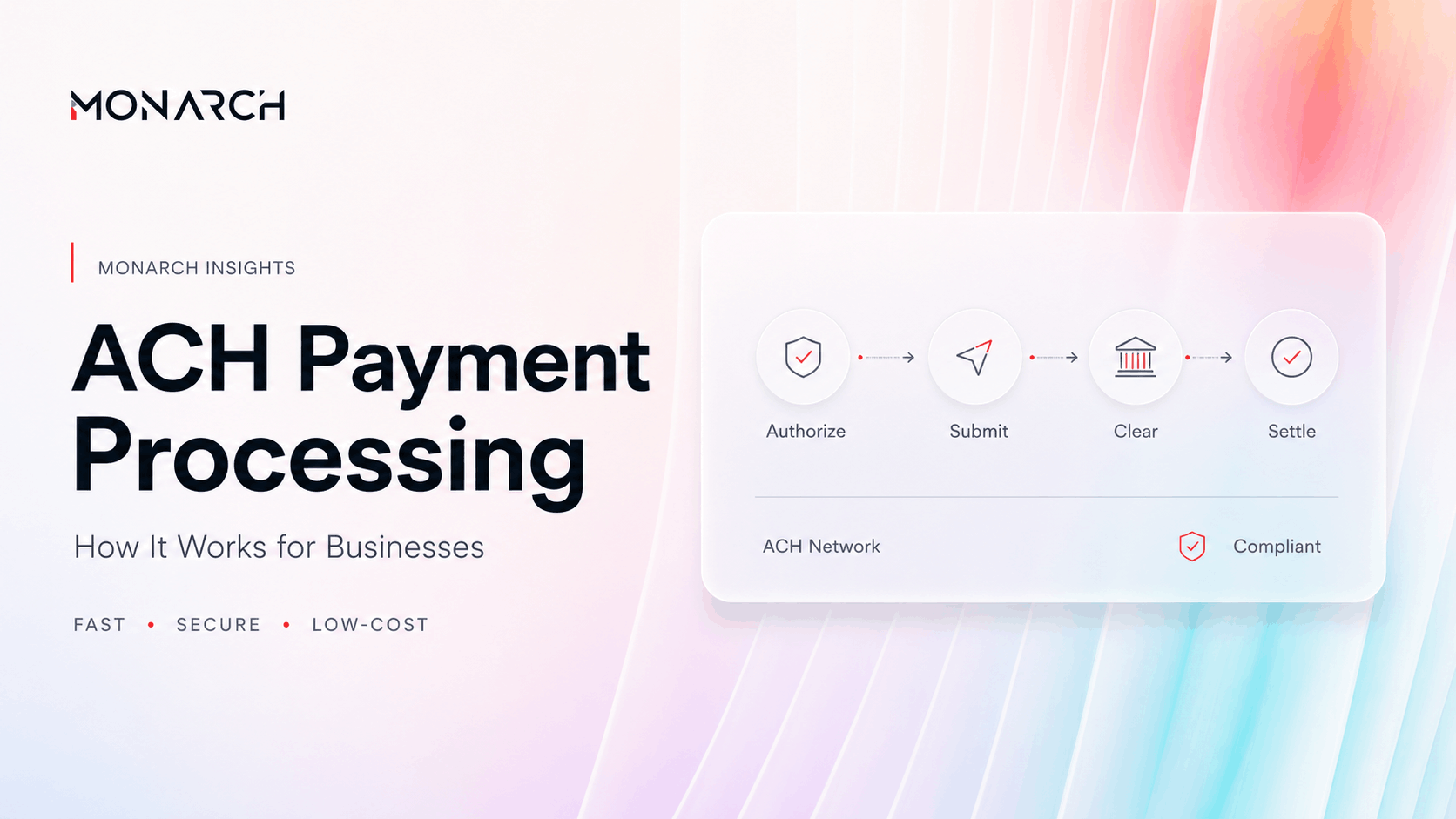
TL;DR Automated Clearing House (ACH) payments are a secure, low-cost electronic funds transfer network used by millions of businesses across the United States. If you pay employees, collect recurring payments from customers, or move money between accounts, understanding how ACH works – and how to use it properly – can save your business time, money and expensive compliance headaches.
Thank you for reading this post, don't forget to subscribe!
Introductory
At some point, every business has to answer a fundamental question: How do we move money efficiently and securely?
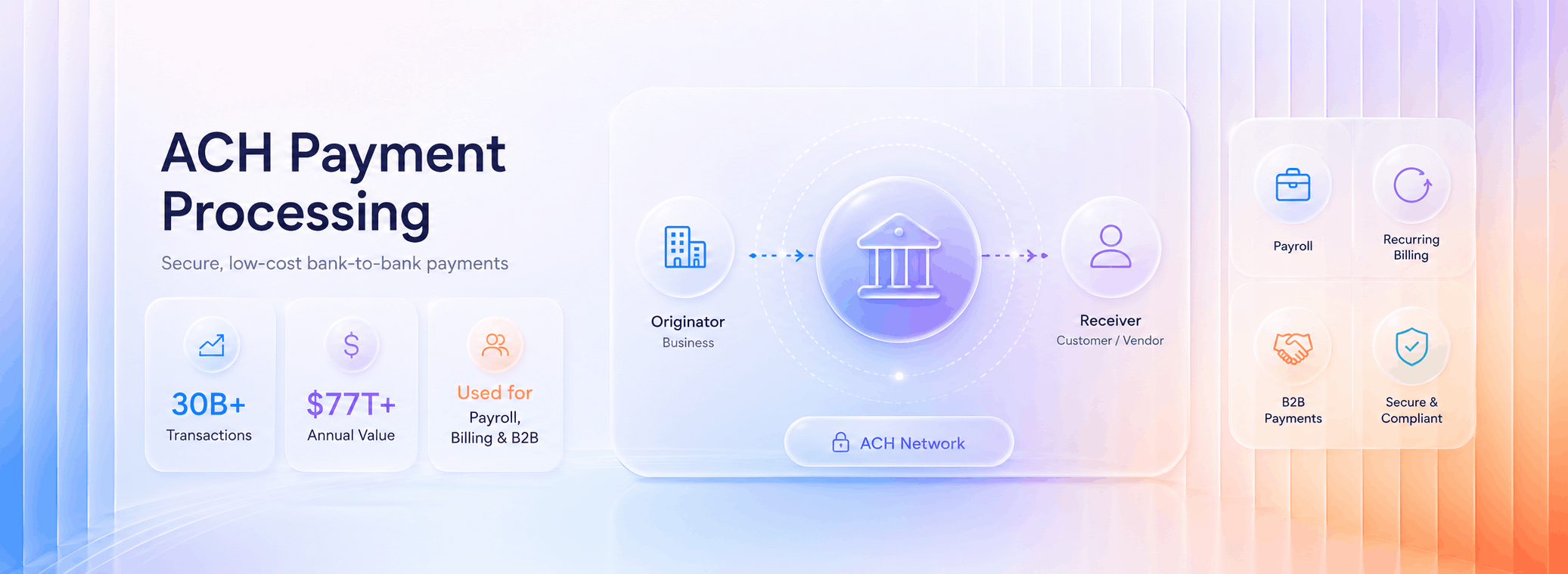
Cash is slow and dangerous. Paper checks are a thing of the past. Card payments have interchange fees that eat into margins. That’s why ACH payment processing has become the very backbone of today’s business finance – processing over 30 billion transactions worth over $77 trillion annually in the United States alone.
However, many business owners do not fully grasp how the system works, what can go wrong, and how to choose the right payment infrastructure to support their business operations, despite its widespread use.
This guide will walk you through everything you need to know about ACH payment processing — how the money actually moves, common pitfalls, and what makes a good ACH processor vs. one that will cost you down the line.
What Is ACH Payment Processing?
ACH stands for Automated Clearing House and is a U.S. financial network for electronic money transfers between bank accounts. It’s governed by NACHA (the National Automated Clearing House Association), which establishes the rules, standards, and compliance requirements for every transaction that flows through the network.
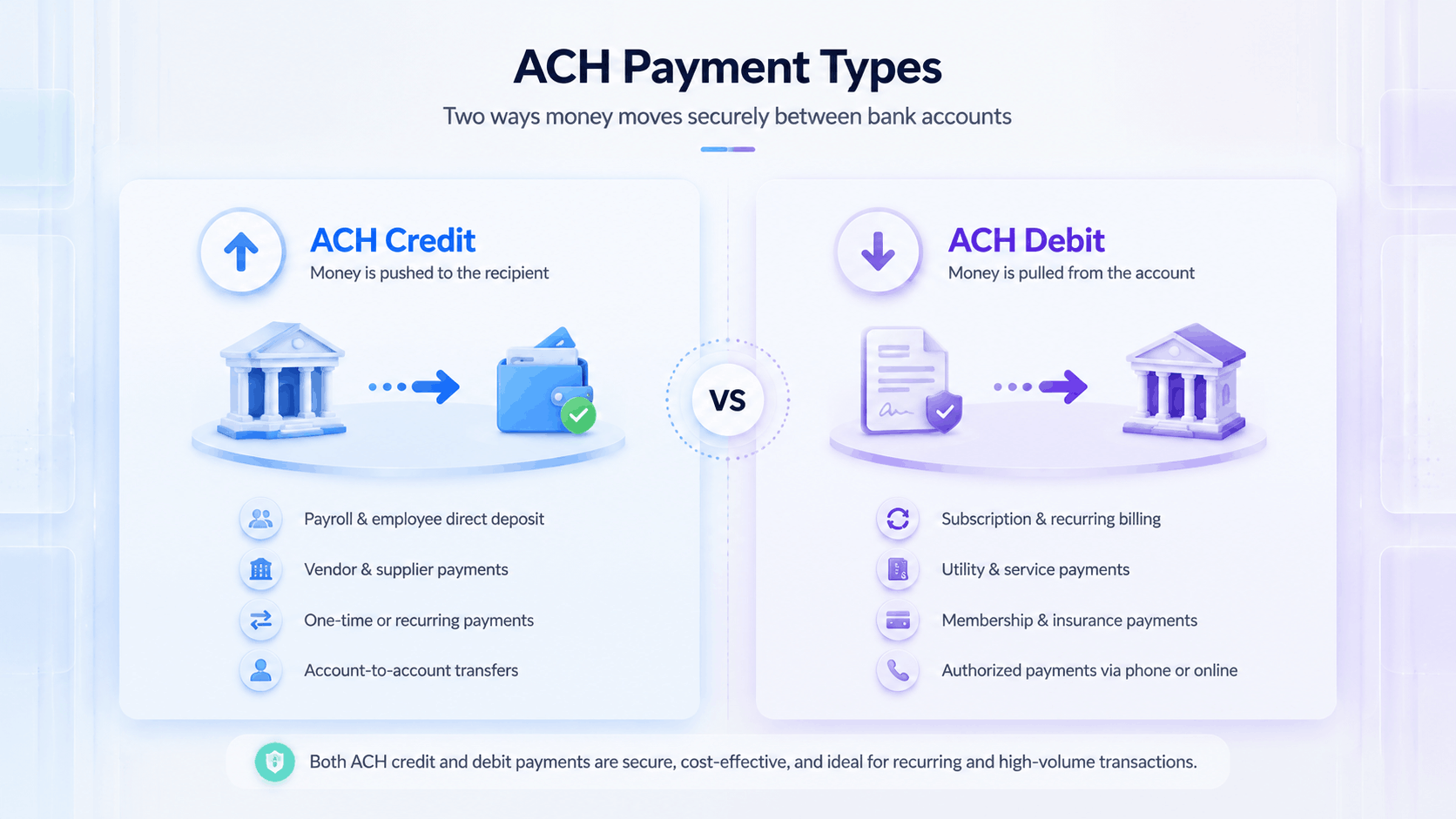
There are two types of ACH payments:
● ACH Credit – The sender sends money to the recipient’s account. an employer paying employees through payroll
● ACH Debit — The originator pulls funds from a customer or vendor account. Example: subscription service that takes money out of a customer’s bank account monthly.
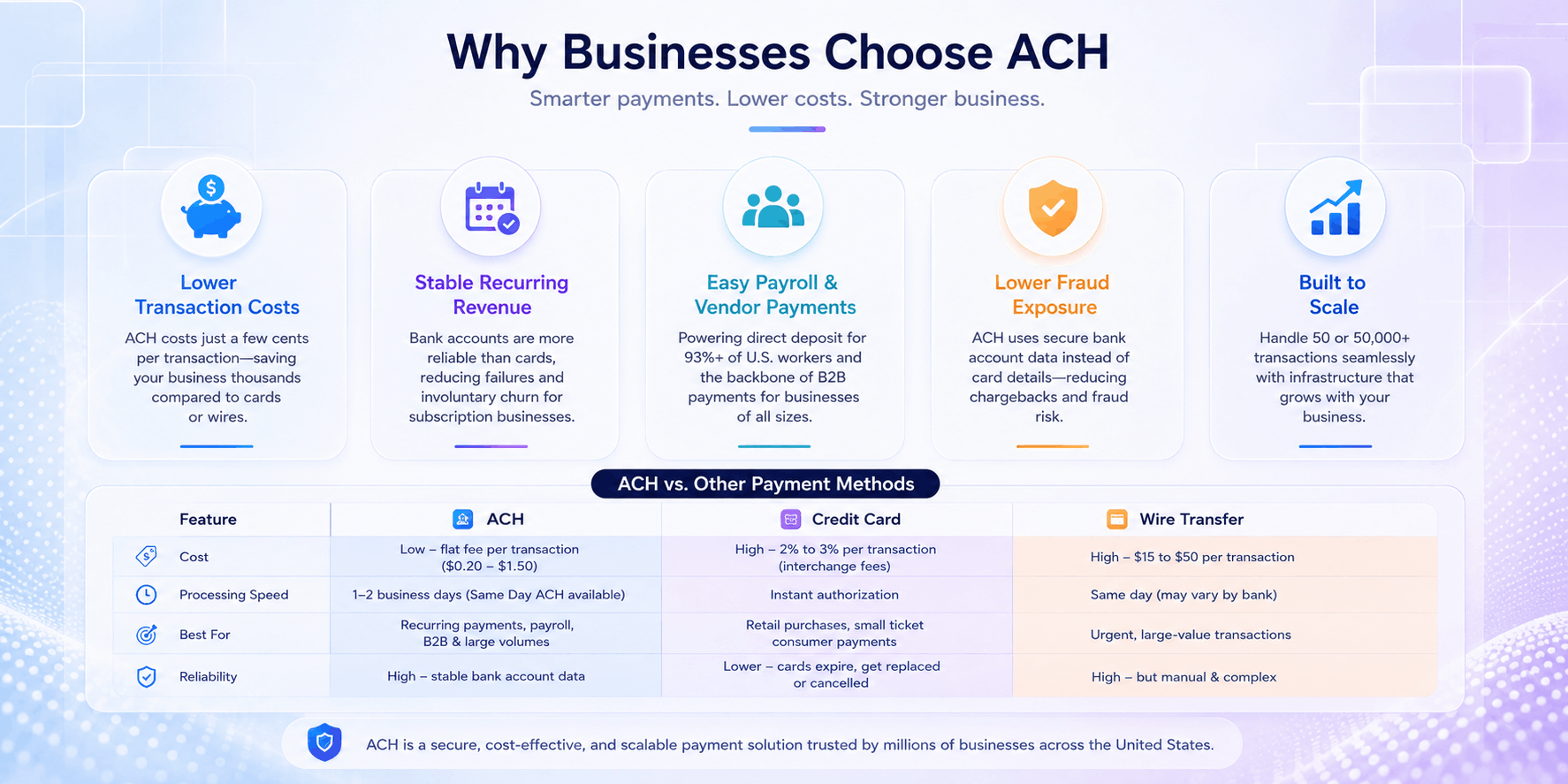
Wire transfers are processed in real time individually, while ACH transactions are batched and processed in cycles throughout the business day. That makes them much cheaper — often just a few cents per transaction vs $15-50 for a wire transfer.
How Does ACH Payment Processing Work? A Step-by-Step Breakdown
For any business that wants to avoid errors, delays or compliance issues, understanding the ACH flow is key.
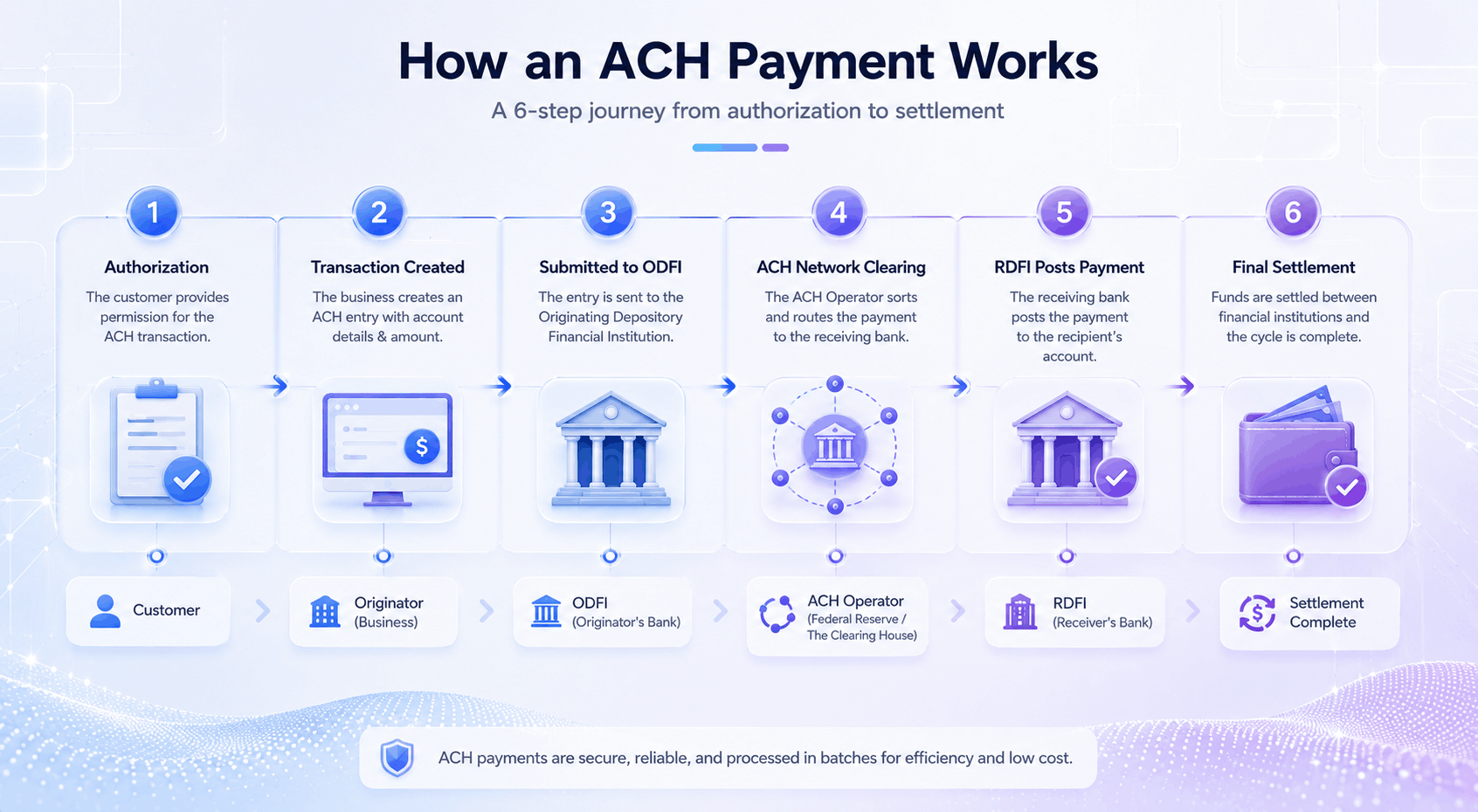
Step 1: Provide permission
Before any ACH transaction, the business (called the Originator) must have proper authorization from the account holder. This can be done by signing a paper form, giving online authorization or giving a recorded verbal agreement, depending on the type of transaction.
Skipping or not properly documenting this step is one of the most common causes for ACH returns and NACHA violations.
Step 2. Enter Transaction
The Originator (or the Originator’s payment processor) creates an ACH entry, a standardized data file containing the routing number, account number, transaction amount and entry class code (PPD for personal accounts or CCD for corporate accounts).
Step 3: Submission to ODFI
The ACH entry is forwarded to the Originating Depository Financial Institution (ODFI). This is typically the Originator’s bank or a third-party payment processor licensed to do business. The ODFI validates the file and batches it for submission into the ACH Network.
Step 4: Clearing via the ACH Network
The batched transactions are sent to the ACH Operator (the Federal Reserve or The Clearing House). The ACH Operator sorts the transactions by receiving institution. NACHA’s ongoing Same Day ACH expansion has resulted in the majority of transactions clearing on the same-day or next business day.
Step 5: Credit or Debit at RDFI
The Receiving Depository Financial Institution (RDFI)—the recipient’s bank—posts the transaction to the account. At this point the RDFI can also return the transaction if something is wrong (insufficient funds, closed account, unauthorized, etc.).
Step 6: Turn off
Financial institutions settle money with each other. The Originator’s account is either debited or credited, as appropriate, and the payment cycle is complete. ________________________________________ Common
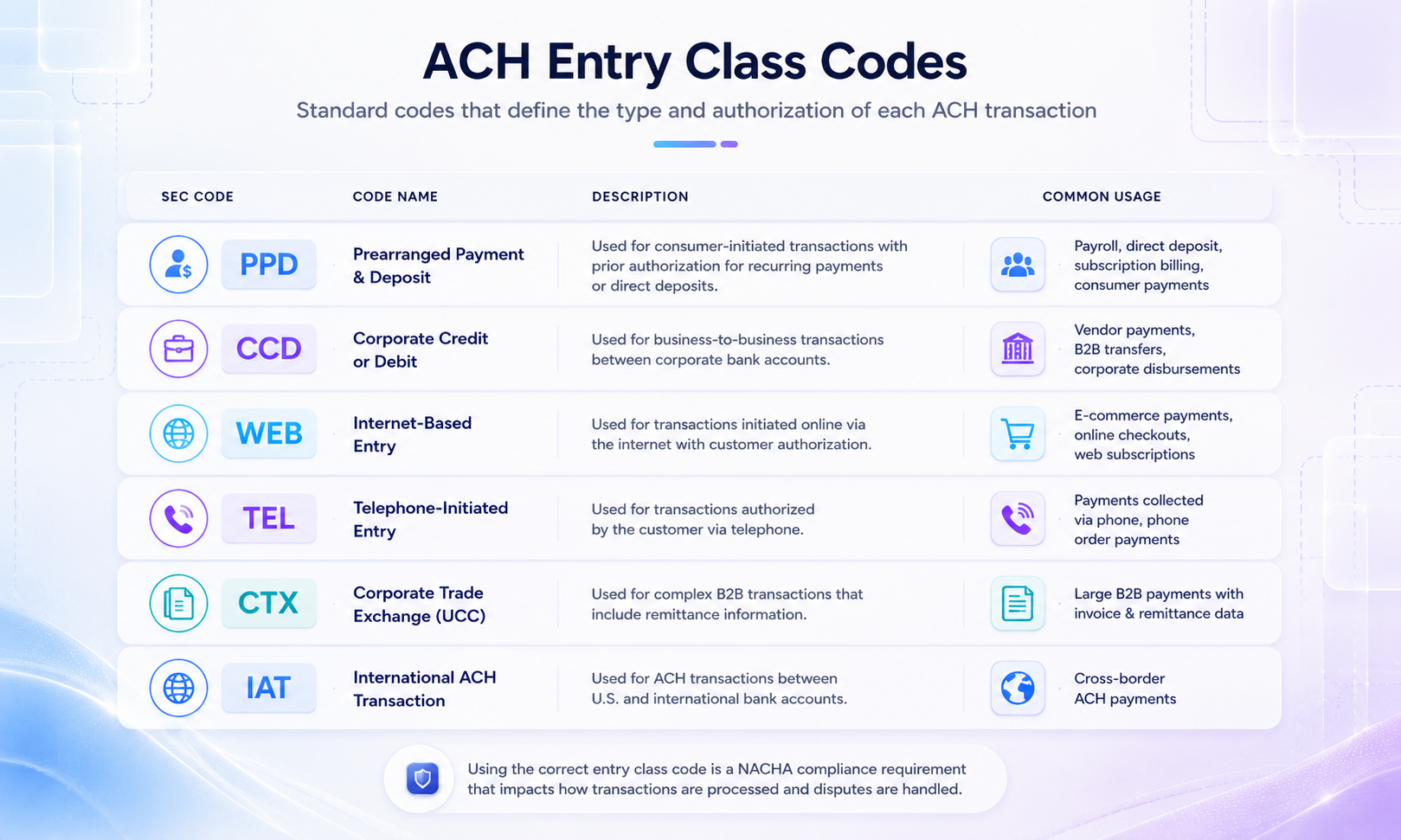
ACH Entry Class Codes Every Business Should Know
NACHA requires that each ACH transaction must include a Standard Entry Class (SEC) code that describes the type of transaction and the method of authorization used. Failure to use the proper code may lead to returns, penalties or compliance violations.
SEC Code Description Common Usage Scenario
PPD Prearranged Payment & Deposit Payroll, recurrent consumer billing
CCD Corporate Credit or Debit Vendor payments, B2B payments
WEB Internet-based entry Online checkout, e-commerce
TEL Telephone initiated entryPayments collected via phone
CTX Corporate Trade Exchange (UCC)Complicated B2B transactions with remittance
IAT International Automated Clearing House TransactionACH payments across borders
It’s not optional to select the proper SEC code – it’s a NACHA compliance requirement that has a direct impact on how transactions are processed and disputes are handled.
Why ACH Payment Processing is Important for Your Business
1. Cost Effectiveness
ACH fees are generally $0.20 to $1.50 per transaction versus 2-3% interchange fees on card payments. For high volumes or large transaction amounts, this difference can amount to thousands of dollars per year.
2. Recurring Revenue Stability
ACH is the gold standard in subscription billing and recurring payments. Bank accounts are far more stable (unlike credit cards that expire or get cancelled) reducing involuntary churn for subscription-based businesses.
3. Vendor and Payroll Payments
More than 93% of U.S. workers are paid through direct deposit, all powered by ACH. Companies also rely heavily on ACH to pay suppliers, contractors and service providers on predictable schedules.
4. Lower fraud exposure
ACH transactions use your bank account information instead of card information, which makes them less vulnerable to card-not-present fraud. ACH, along with a licensed compliant payment processor, provides a good layer of financial security.
5. Scalablity
whether you’re processing 50 transactions a month or 50,000 ACH infrastructure scales without the per-transaction spikes of card networks.
Typical ACH Processing Challenges – and How to Avoid Them
Challenge 1: ACH Returns
Returns occur when a transaction can not be completed. Typical return codes include:
● R01 – Not Enough Money
● R02 – Closed Account● R03 – No Account/Can’t Find Account
● R05 – Debit Entry Not Allowed
● R10 – Customer Not Authorised Advises
A high return rate can indicate issues with your authorization practices, data quality or customer communication, and can lead to NACHA audits or even suspension from the ACH network.
How to prevent it: Use bank account verification (micro-deposits or real-time verification) before you begin any transactions. * Maintain clear, written authorization for all debit entries.
Challenge 2: Settlement and Timing Delays Businesses that don’t know about ACH processing windows often experience cash flow gaps. Same Day ACH sped things up a lot, but not all types of transactions qualify and each processor has cutoff times.
How to prevent it: Work with a payment processor that is transparent about processing windows and offers Same Day ACH where possible.
Challenge 3: Compliance BreachesThe rules of NACHA change frequently. Third-Party Senders (TPS) are companies that transmit ACH entries on behalf of others. TPS are held to more stringent compliance standards, including registration, auditing, and risk management.
How to prevent it: Ensure that the processor has correct licensing and TPS certification so that compliance duties are appropriately handled.
Challenge 4: Fraud and unauthorised entries
ACH fraud, especially unauthorized debits, is an increasing worry for businesses on either side of a transaction. Unauthorized ACH entries can result from account takeover attacks and social engineering schemes, which are difficult to reverse once settled.
How to avoid: 1. Enable multi-factor authentication on all payment accounts, monitor transactions in real-time and partner with a processor that has strong fraud detection controls.
Choosing an ACH Payment Processor: Things to Consider
Selecting the right ACH processor is one of the most important decisions a business must make. Here’s what to check:
Licensing & Regulatory Status Your processor must have the appropriate state and federal licenses, including a Money Transmitter License (MTL), where required. This is not an option – this protects your business in the event of a regulatory inquiry.
NACHA Compliance & TPS Certification If your processor is initiating ACH entries on your behalf, they should be registered as a Third-Party Sender with a documented compliance program.
Management transparency back Inquire about the procedure for dealing with returns, how soon you will be contacted, and what tools are at your disposal to help you decrease your return rate over time.
Multi-Rail Payment Feature The best processors don’t just do ACH. Look for platforms that also support wire transfers, digital wallets, and international payment rails — so your infrastructure can scale with your business.
“Automated Disbursement Support Look for processors that support automated disbursement workflows with multiple payout options (ACH, direct-to-wallet, etc.) if your business pays out commissions, settlements, or partner payouts.. ________________________________________ How Monarch Works for ACH Businesses
Monarch is a registered money transmitter with a full compliance infrastructure built for the complexity of today’s payment processing. Monarch is a certified Third-Party Sender and assumes the NACHA compliance obligations that many businesses find challenging to manage on their own.
Built on Monarch’s platform:
● ACH (Automated Clearing House) origination and processing for recurring billing, B2B payments and payrol
● Disburse – API-driven disbursement engine for commission payments, settlements, and partner payouts via ACH and direct-to-wallet
● Monarch Tax Authority – Automated jurisdictional tax calculation and remittance to keep your ACH powered business compliant at the state level
● Helox – a compliant contactless payments platform for businesses in regulated industries
Whether it’s a fintech product, scaling a licensed business, or a complex payment workflow, we’ve got you covered with the infrastructure to do it securely and compliantly.
Conclusion
ACH payment processing isn’t complicated, but doing it right takes more than just hooking up to a payment gateway. It takes understanding the rules, choosing the right infrastructure and working with partners that have the right licenses and compliance credentials.
This is especially the case for companies that process recurring payments, manage agent commissions, or work in regulated industries. One slip in compliance can lead to NACHA fines, loss of banking relationships or regulatory action.
The good news is that you don’t have to do this on your own. With the right payment infrastructure in place, ACH is one of the most powerful tools in your financial operations stack.
Are you ready to simplify your ACH payment operations? Schedule a Monarch Demo to see how our compliant and licensed infrastructure can work for your business.
About Monarch Monarch is a registered money transmitter and a financial infrastructure company focused on payments, compliance, tax remittance, and cash logistics for regulated industry businesses.