

ACH vs Wire Transfers: Which Payment Method Is Right for Your Business?
By Monarch | Financial Infrastructure for Modern Commerce
Thank you for reading this post, don't forget to subscribe!
TL;DR: ACH and wire transfers are both electronic payment methods, but they serve very different business needs. Understanding the key differences—speed, cost, security, and use cases—helps businesses make smarter decisions about how they move money. The right choice depends on your industry, transaction size, and how quickly funds need to arrive.
Introduction: Two Ways to Move Money Electronically
Every day, businesses across the United States move billions of dollars through electronic payment networks. Whether you’re paying vendors, settling invoices, disbursing commissions, or collecting customer payments, you’ve likely used either ACH transfers or wire transfers to get the job done.
But here’s a question many business owners struggle to answer clearly: What’s the actual difference between ACH and wire transfers—and which one should I be using?
The answer isn’t one-size-fits-all. Each method has distinct advantages and limitations, and choosing the wrong one can cost your business time, money, and in some cases, compliance headaches. This guide breaks down everything you need to know about ACH vs wire transfers so you can make the right call for your specific situation.
What Is an ACH Transfer?
ACH stands for Automated Clearing House—a nationwide electronic network managed by NACHA (the National Automated Clearing House Association) that facilitates the movement of money between bank accounts across the United States.
ACH transfers are the backbone of everyday American financial life. When your payroll hits your employees’ bank accounts on Friday morning, that’s ACH. When you pay your utility bill online, that’s ACH. When a customer sets up autopay for a subscription service, that’s ACH.
For businesses, ACH transfers come in two forms:
- ACH Credit — You push funds from your account to someone else’s (e.g., paying employees or vendors)
- ACH Debit — You pull funds from someone else’s account into yours (e.g., collecting customer payments)
ACH transactions are processed in batches—meaning they don’t move instantly. Standard ACH typically settles within 1–3 business days, though same-day ACH is now available for qualifying transactions.
What Is a Wire Transfer?
A wire transfer is a direct, bank-to-bank electronic payment that moves funds in real time—or close to it. Unlike ACH, wire transfers are processed individually rather than in batches, which is why they’re significantly faster.
Wire transfers can be:
- Domestic — Sent between U.S. bank accounts, typically settling the same business day
- International — Sent across borders through networks like SWIFT, usually settling within 1–5 business days depending on the destination country and currency
Wire transfers are commonly used for large, time-sensitive transactions—real estate closings, business acquisitions, international supplier payments, and high-value B2B settlements where speed and certainty are non-negotiable.

ACH vs Wire Transfers: A Side-by-Side Comparison
| Feature | ACH Transfer | Wire Transfer |
| Speed | 1–3 business days (same-day ACH available) | Same day (domestic) / 1–5 days (international) |
| Cost | Low ($0.20–$1.50 per transaction) | Higher ($15–$50 domestic / $25–$75 international) |
| Transaction Limits | Varies by bank (often $25,000–$100,000/day) | No standard limit |
| Reversibility | Reversible in some cases | Generally irrevocable once sent |
| Best For | Recurring payments, payroll, vendor payments | Large, urgent, or international payments |
| Geographic Reach | Domestic U.S. only | Domestic and international |
| Processing | Batch processing | Individual processing |
Key Differences Explained
1. Speed
This is often the deciding factor. If you need funds to arrive today—a real estate closing, an urgent international supplier payment, a same-day settlement—a wire transfer is your only reliable option. ACH simply cannot guarantee same-day delivery for all transaction types, even with same-day ACH services.
For non-urgent transactions, ACH’s 1–3 day window is typically more than acceptable, and the cost savings add up significantly over time.
2. Cost
ACH transfers are dramatically cheaper than wire transfers. A typical ACH transaction costs a business anywhere from $0.20 to $1.50. Wire transfers, by contrast, can cost $15 to $50 for domestic transfers and $25 to $75 or more for international wires—and that’s often on top of fees charged by the receiving bank.
For businesses processing high transaction volumes—payroll runs, vendor payments, commission disbursements—the difference between ACH and wire costs can amount to tens of thousands of dollars per year.
3. Reversibility
One of the most important and often overlooked differences: wire transfers are nearly impossible to reverse once sent.
If you send a wire transfer to the wrong account or for the wrong amount, recovering those funds is extremely difficult and not guaranteed. ACH transfers, on the other hand, offer more flexibility. Under NACHA rules, certain ACH transactions can be reversed if an error is caught quickly—typically within five business days of the original settlement date.
This reversibility makes ACH a lower-risk option for routine business payments where errors might occasionally occur.
4. Transaction Size
Wire transfers have no standard upper limit, making them the preferred method for very large transactions—think $500,000 real estate deals or multi-million-dollar equipment purchases. ACH transfers, while increasingly capable of handling larger amounts, are still subject to daily limits set by individual banks and processors.
5. Geographic Reach
ACH is a domestic U.S. payment network. If you need to send money internationally, wire transfers are the standard mechanism. International ACH transactions (IAT) do exist but are limited in scope and adoption.
When Should Your Business Use ACH?
ACH is the right choice when:
You’re running payroll. ACH is the standard method for direct deposit across the U.S. It’s cost-effective, reliable, and expected by employees.
You’re collecting recurring customer payments. Subscription billing, installment plans, and autopay setups are all ideal ACH use cases. The low cost per transaction makes ACH far more economical than card payments for recurring billing.
You’re paying vendors and suppliers regularly. Regular, predictable vendor payments are a perfect fit for ACH. The 1–3 day settlement window is usually acceptable, and the cost savings versus wire are significant.
You’re disbursing commissions to agents or sales teams. High-volume commission payments to multiple recipients are efficiently handled through ACH, especially when using an automated disbursement platform.
The transaction amount is under your bank’s ACH limit. For most routine business payments, ACH limits are more than adequate.
When Should Your Business Use Wire Transfers?
Wire transfers are the better choice when:
Speed is critical. If a payment absolutely must arrive today, wire is your tool. Real estate transactions, legal settlements, and time-sensitive supply chain payments often fall into this category.
You’re sending a large, one-time payment. High-value transactions where certainty of delivery outweighs cost concerns are well-suited for wire.
You’re paying an international supplier or partner. ACH doesn’t cross borders. For international payments, wire transfers via SWIFT are the established standard.
The recipient requires guaranteed, irrevocable funds. Because wire transfers are essentially final once sent, some counterparties—especially in real estate or large asset purchases—require wire as a condition of the transaction.
Common Mistakes Businesses Make When Choosing Between ACH and Wire
Using wire transfers for routine payments out of habit. Many businesses default to wire transfers simply because that’s what they’ve always done—or because they assume wires are more secure. The reality is that ACH is equally secure for most business payments, at a fraction of the cost.
Using ACH for urgent payments. Assuming a next-day ACH will arrive on time for a time-sensitive obligation is a risk. If a payment absolutely must arrive by a specific time, verify that same-day ACH is available and confirmed—or use a wire.
Not verifying account information before sending either type of transfer. Both ACH and wire fraud often begin with manipulated account information. Always verify account and routing numbers through a trusted, direct channel before initiating any significant transfer.
Failing to account for bank processing cutoff times. Both ACH and wire transfers have daily cutoff times at most banks. Missing a cutoff means your transaction won’t process until the next business day—potentially disrupting operations or missing a critical deadline.
Security Considerations for Both Payment Methods
Both ACH and wire transfers are secure payment methods when handled properly, but each comes with its own fraud risks.
ACH fraud most commonly involves unauthorized debits—where a bad actor uses stolen account and routing numbers to pull funds from a business account. Protecting against ACH fraud requires strong account verification processes, transaction monitoring, and clear authorization protocols.
Wire fraud is often more severe because transfers are irrevocable. Business Email Compromise (BEC) scams—where fraudsters impersonate executives or vendors to redirect wire payments—have cost businesses billions of dollars. Robust verification procedures and dual authorization controls are essential safeguards.
In both cases, working with a payment platform that has enterprise-grade security infrastructure, real-time monitoring, and compliance controls significantly reduces your exposure.
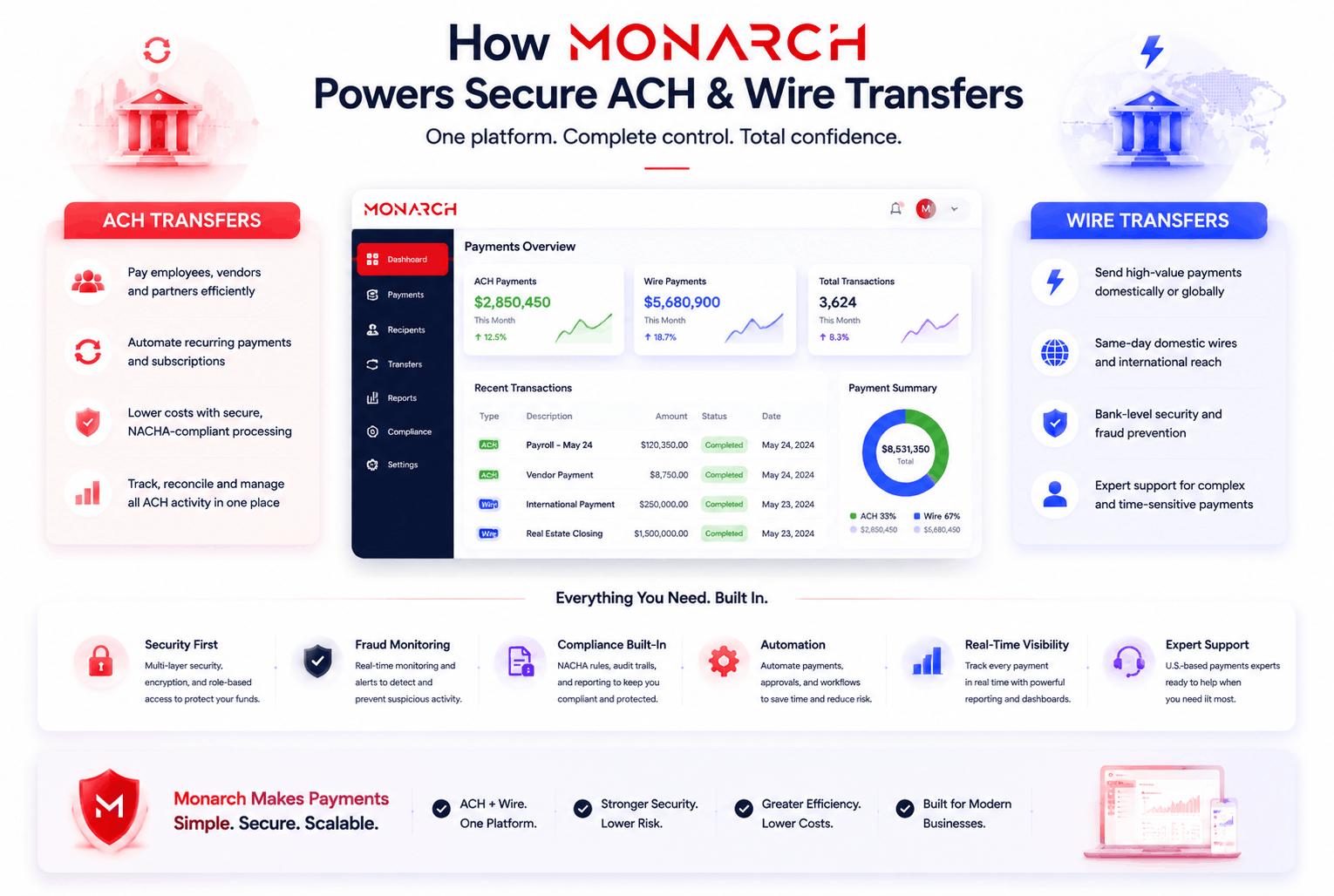
How Monarch Supports Both ACH and Wire Payments
At Monarch, we’ve built a comprehensive financial infrastructure that supports businesses across every stage of their payment operations—including both ACH and wire transfers.
As a licensed money transmitter and certified Third Party Sender (TPS), Monarch operates under strict federal and state regulatory frameworks to ensure every transaction is secure, compliant, and reliable. Our platform offers:
- ACH processing with built-in account verification and transaction monitoring
- Wire transfer facilitation for domestic and time-sensitive payments
- Automated compliance to keep your transactions aligned with NACHA rules and state regulations
- Real-time reporting and analytics for full visibility into your payment operations
- Disburse — our automated commission and settlement payment tool — built natively on ACH infrastructure for high-volume business disbursements
Whether your business needs the cost efficiency of ACH for everyday operations or the speed of wire transfers for critical payments, Monarch provides the secure, compliant foundation to make it happen.
Final Thoughts: Choosing the Right Payment Method for Your Business
ACH and wire transfers both serve important roles in modern business payments. The key is knowing when to use each one.
Use ACH when cost efficiency, volume, and routine reliability matter most. Use wire transfers when speed, transaction size, or international reach are the priority. And in both cases, make sure you’re working with a payment infrastructure that prioritizes security, compliance, and transparency.
The businesses that get this right don’t just save money on transaction fees—they build more resilient, more trustworthy payment operations that support long-term growth.
Want to streamline your ACH and wire transfer operations with a fully licensed, compliant payment platform? Schedule a Demo with Monarch and discover how our financial infrastructure can support your business at every stage.