
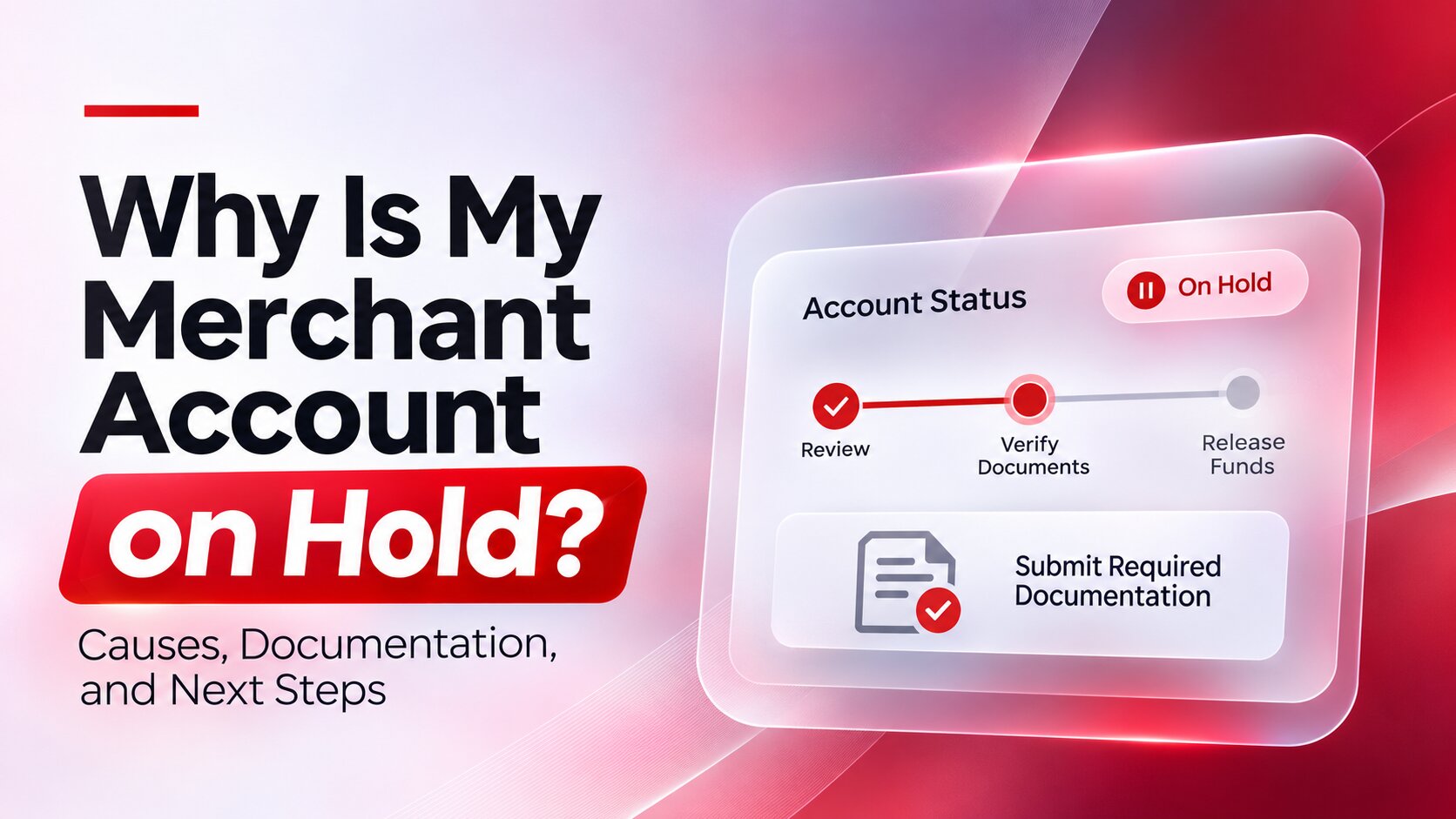
Your sales are coming in. Customers are paying. But the money isn’t reaching your bank account.
Thank you for reading this post, don't forget to subscribe!
Few things can disrupt a business faster than discovering that thousands of dollars in payments are suddenly unavailable.
You have suppliers waiting, employees to pay, inventory to restock, and bills that won’t wait for a payment processor to finish reviewing your account.
If your merchant account on hold notice appeared without much explanation, you’re probably asking three questions: Why did this happen? How long will it last? And what can I do to get my money released?
The good news is that a payment hold doesn’t automatically mean your business has done something wrong. Payment processors sometimes restrict payouts while reviewing transactions, confirming business information, or evaluating financial risk.
What matters now is understanding the specific restriction, responding with the right documentation, and taking practical steps to protect your cash flow.
Here’s what business owners need to know.
What Does It Mean When Your Merchant Account Is on Hold?
A merchant account hold occurs when a payment provider temporarily restricts access to some or all of the money processed through your business.
In many cases, customers can still complete purchases, but you cannot receive the associated payouts on your regular settlement schedule.
Other restrictions may affect your ability to accept new transactions altogether.
The exact impact depends on your payment provider, account agreement, and reason for the review.
For example, imagine you operate an online retail business that processes approximately $50,000 in monthly card payments.
Everything has been running smoothly until your processor flags an unexpected increase in transaction volume.
Instead of transferring your latest payments, the provider asks you to submit additional business documentation.
Your money may remain unavailable while the review is underway.
That’s a payment hold.
However, several different restrictions are commonly described as holds:
- Temporary payout hold: Funds are withheld while the provider reviews the account.
- Rolling reserve: A percentage of processed payments is set aside for a defined period.
- Settlement delay: Payments take longer than usual to reach your bank.
- Processing restriction: Some or all new transactions may be blocked.
- Account suspension: Your provider limits or terminates certain account functions.
These distinctions matter because each situation may require a different response.
A reserve, for example, isn’t necessarily an account suspension. Some businesses continue accepting payments while part of their balance remains reserved.
Before taking action, identify exactly what your processor has restricted.
7 Common Reasons Payment Processors Put Merchant Accounts on Hold
When a business discovers its merchant account on hold, the underlying issue usually involves transaction risk, financial exposure, account verification, or compliance requirements.
Understanding these factors can help you respond more effectively.
1. Unexpected Increases in Processing Volume
A sudden spike in revenue sounds like great news.
From a payment processor’s perspective, however, unusually high transaction volume may require additional review.
Suppose your business typically processes $15,000 monthly, then suddenly processes $90,000 following a successful marketing campaign.
Your provider may want to confirm that the increase reflects legitimate sales and that your business can fulfill the associated orders.
Large changes in average transaction size can raise similar questions.
What you can do:
Prepare recent transaction reports, invoices, shipping confirmations, sales records, and a brief explanation of the increase.
If your business expects seasonal sales spikes or major promotional campaigns, communicate anticipated volume changes to your provider beforehand.
2. High Chargeback or Dispute Activity
Chargebacks happen when customers dispute card transactions through their banks.
A sudden increase in disputes may suggest problems with order fulfillment, product expectations, billing descriptions, or customer service.
Even legitimate businesses can experience chargeback spikes during delivery delays, subscription changes, or unusually busy sales periods.
Processors monitor this activity because unresolved disputes can create financial exposure.
What you can do:
Review your recent disputes and look for patterns.
Are customers complaining about delayed deliveries? Are they failing to recognize your billing descriptor? Are refund requests going unanswered?
Addressing the underlying problem matters more than simply disputing every chargeback.
Maintain clear refund policies, respond promptly to customer inquiries, and preserve evidence of fulfilled orders.
3. Incomplete or Outdated Business Information
Payment providers need accurate information about the businesses using their services.
Depending on the provider and applicable requirements, this may include:
- Legal business name and registration details
- Employer Identification Number (EIN) or other tax information
- Beneficial ownership information
- Business address
- Identity verification documents
- Banking information
- Product and service descriptions
If your company’s information changes and your payment provider isn’t notified, your account may be flagged for review.
For example, changing your legal business entity or bank account without completing the required verification process could delay payouts.
What you can do:
Compare your merchant account profile against your current business records.
Make sure legal names, addresses, ownership information, websites, and banking details are accurate and consistent.
When documentation is requested, submit current records through the provider’s approved channel.
4. Products or Services Outside the Approved Business Profile
Payment processors evaluate businesses partly based on what they sell.
An account approved for one business model may require additional underwriting if the merchant introduces materially different products or services.
This is especially relevant in industries subject to additional legal, regulatory, or payment-network requirements.
A processor may also review businesses that advertise products differently from how those products were described during onboarding.
What you can do:
Review your merchant agreement and the product categories you originally disclosed.
Ensure your website accurately describes your goods, services, shipping arrangements, and refund policies.
If your business model has changed, notify your provider and request clarification about eligibility before processing transactions outside your approved scope.
Do not attempt to avoid restrictions by disguising products, changing transaction descriptions, or misrepresenting your business.
5. Unusual Transaction Patterns or Potential Fraud
Processors monitor transactions for patterns that may indicate fraud or elevated risk.
Examples may include unusual transaction sizes, unexpected cross-border activity, repeated payment attempts, or significant changes in customer purchasing behavior.
An alert doesn’t prove fraudulent activity occurred.
It may simply indicate that the provider needs more information.
What you can do:
Examine the flagged transactions and provide supporting records.
If you identify unauthorized activity, follow your provider’s incident-response instructions immediately.
Strengthen appropriate payment security controls and ensure employees know how to escalate suspicious activity.
6. Refund Exposure and Delayed Fulfillment
Businesses that accept payment before delivering products or services can create financial exposure for processors.
Consider a company collecting large upfront payments for custom orders scheduled for delivery several months later.
If the company cannot complete those orders, customers may request refunds or initiate disputes before the merchant has sufficient funds available.
A provider may respond by introducing a reserve or additional settlement controls.
What you can do:
Maintain documentation showing your fulfillment capacity, current orders, expected delivery dates, and refund obligations.
Avoid making delivery promises your business cannot reliably meet.
Where appropriate, develop clearer payment milestones and communicate realistic fulfillment timelines.
7. Financial or Compliance Review
A payment hold can also result from ongoing underwriting, bank-partner requirements, financial reviews, or regulatory compliance checks.
Your processor might request information concerning beneficial ownership, business activity, funding sources, or transaction history.
Some reviews are routine. Others arise after a material change in business operations.
What you can do:
Ask the provider what category of information is required and whether the restriction is related to routine verification, financial risk, or a specific compliance concern.
Respond accurately and promptly.
If the provider cannot disclose certain details, request a written explanation of the next available step and the applicable review process.
Merchant Account Hold vs. Rolling Reserve: What’s the Difference?
One of the most confusing aspects of payment processing is understanding why funds are unavailable.
A temporary hold and a rolling reserve are not always the same thing.
A merchant account hold may prevent you from accessing a particular balance while your processor reviews your account.
A rolling reserve generally involves withholding a specified percentage of transactions and releasing the retained amounts according to an agreed schedule, subject to the applicable terms.
For example:
Suppose your business processes $40,000 in eligible monthly card payments and your provider applies a 10% rolling reserve.
That could mean $4,000 is set aside, while the remaining amount is handled according to your payment agreement, fees, and settlement terms.
If the reserve is held for 90 days, eligible funds may become available after that period, provided they are not needed for covered disputes or refunds.
This example is illustrative, not a standard reserve rate or promise of release.
Some providers use fixed reserves, rolling reserves, or other risk-management arrangements.
Always review the actual written terms of your account.
You should understand the amount withheld, the reason for the restriction, the scheduled release conditions, and whether the reserve may be reviewed or changed.
What Documents Do You Need to Release a Merchant Account Hold?
Documentation is often a central part of the review process.
The specific requirements depend on the processor and the reason for the restriction, but preparing an organized response can reduce avoidable delays.
Business Identity Documents
Your provider may request:
- Business registration or formation documents
- EIN confirmation or applicable tax records
- Government-issued identification from an authorized representative
- Proof of business address
- Beneficial ownership information
- Current business licenses, where applicable
Make sure the information matches your merchant account.
Financial Documents
Depending on the review, requested information may include:
- Recent business bank statements
- Financial statements
- Processing history
- Sales reports
- Refund records
- Evidence of available operating funds
These documents may help a provider understand your company’s financial position and ability to satisfy outstanding obligations.
Transaction and Fulfillment Records
If particular transactions triggered the review, your processor may ask for:
- Customer invoices
- Order confirmations
- Shipping and delivery records
- Contracts or service agreements
- Proof of completed services
- Customer communications
- Refund or cancellation documentation
Organize these records by transaction ID whenever possible.
Submitting unrelated documents can make an already complicated review harder to follow.
Website and Policy Information
Your business website may also be evaluated.
Review whether it clearly displays your products or services, pricing, contact information, fulfillment terms, privacy practices, and applicable refund policies.
If a policy is missing or outdated, correct it.
However, website changes alone won’t necessarily remove a payment restriction.
Important: Submit sensitive information only through secure channels specified by your verified payment provider. Avoid sending identity documents or banking records to unfamiliar email addresses.
What to Do Immediately If Your Merchant Account Is on Hold
Discovering a merchant account on hold can be stressful, particularly when payroll, inventory purchases, or vendor obligations are approaching.
The best response is organized and factual.
Step 1: Read the Notice Carefully
Start with the exact message from your processor.
Determine whether your account is under review, payouts are paused, a reserve has been imposed, or processing has been suspended.
Save the notice and any case or reference number.
Step 2: Contact Your Payment Provider
Use the official support channel.
Ask:
- What restriction has been applied?
- What is the stated reason or review category?
- Which documents or actions are required?
- Is there an estimated review date?
- What conditions determine fund release?
- Is there an escalation or reconsideration process?
Request written confirmation when possible.
Step 3: Prepare a Complete Documentation Package
Collect only the information relevant to the request.
Use clear filenames, ensure documents are readable, and check for inconsistencies.
For transaction-related reviews, include a short explanation connecting the evidence to the flagged activity.
Step 4: Respond Promptly and Accurately
Delaying your response can prolong the process.
But speed should not come at the expense of accuracy.
Never submit altered documents or inaccurate business information.
If you cannot provide a requested document, explain why and ask whether an acceptable alternative exists.
Step 5: Review Your Immediate Cash-Flow Needs
A payment restriction can create serious operating pressure.
Estimate your available cash, near-term obligations, expected deposits, and essential expenses.
Prioritize payroll, critical suppliers, and other legally required payments as appropriate.
If necessary, discuss payment schedules with vendors before obligations become overdue.
Do not assume held funds will become available on a particular date unless your provider has confirmed the applicable conditions.
Step 6: Track Every Communication
Keep a record of support tickets, document submissions, emails, and review updates.
An organized timeline makes follow-up easier and helps prevent conflicting information.
Step 7: Correct Any Underlying Business Issues
Getting a hold lifted is important.
Preventing the same problem from happening again is equally valuable.
If the restriction was connected to high dispute activity, improve fulfillment and customer support.
If the issue involved inaccurate business information, update your records.
If the processor identified a change in your transaction activity, discuss future processing expectations.
How Long Does a Merchant Account Hold Last?
There is no universal timeline.
A review involving missing identification documents may be resolved differently from one involving major chargeback exposure, suspected fraud, contractual restrictions, or regulatory concerns.
Some reviews move quickly after requested information is received. Others may take considerably longer.
Reserve arrangements can have separate release schedules that extend beyond the immediate account review.
This is why businesses should avoid relying on broad promises such as “all holds are released within seven days.”
The actual timeline depends on your agreement, the type of restriction, and your provider’s decision.
If your merchant account on hold notice does not specify the next review milestone, ask for one.
Request clarification about the expected review process, not just a general estimate.
If necessary, seek qualified legal advice concerning your contractual rights and available remedies.
Can You Prevent Future Merchant Account Holds?
No payment provider can guarantee that an account will never be reviewed.
However, sound business practices can reduce avoidable problems.
Maintain Accurate Business Information
Update your processor when your legal entity, ownership, bank account, business address, or products change.
Monitor Chargebacks and Refunds
Track customer disputes, investigate recurring complaints, and resolve fulfillment problems early.
Communicate Major Changes
If you’re launching a new product line, expecting a substantial sales increase, or entering a different market, determine whether advance notice or updated underwriting is required.
Keep Strong Transaction Records
Maintain organized invoices, customer agreements, shipping evidence, and payment histories.
Good records can support both internal operations and external reviews.
Review Your Payment Agreement
Understand your provider’s reserve provisions, prohibited activities, termination rights, payout schedules, and documentation requirements.
Build a Cash-Flow Buffer
When practical, maintain sufficient operating liquidity to manage routine settlement delays, refunds, and temporary payment disruptions.
Assess Your Payment Infrastructure
As a business grows, payment operations can become more complex.
Multiple payment methods, customer verification requirements, vendor obligations, and regulatory responsibilities may need more coordinated systems.
Review whether your existing financial infrastructure still matches the way your business operates.
The goal isn’t simply to avoid a hold. It’s to build a payment operation that is easier to understand, monitor, and manage.
How Monarch Technologies Supports Business Payment Operations
A payment restriction often reveals a broader business challenge: payment processing, banking relationships, compliance documentation, and day-to-day financial operations may be managed through disconnected systems.
That’s where a more coordinated financial infrastructure approach can be relevant.
Monarch Technologies provides financial technology infrastructure designed to help eligible businesses and financial institutions manage money movement, payment operations, and compliance-related workflows.
Depending on the specific service, applicable requirements, and business eligibility, Monarch’s offerings may address several operational needs.
Payment and Money Movement Infrastructure
Businesses need dependable processes for receiving funds, making payments, and maintaining accurate transaction records.
Monarch describes payment capabilities involving card transactions, ACH, wires, and other supported financial workflows.
For eligible businesses, these services may help organize payment operations within a broader financial infrastructure.
Compliance and Business Verification
Accurate onboarding information and supporting documentation matter throughout a business relationship.
Monarch describes solutions supporting business verification, compliance monitoring, documentation, and audit readiness.
These capabilities may be useful to organizations seeking more structured financial operations.
Banking-Related Infrastructure
Some businesses face additional requirements when establishing or maintaining banking relationships.
Monarch works with financial institution partners to support banking-related solutions for eligible businesses, subject to applicable underwriting and approval.
Monarch is not itself a bank, and service availability depends on the relevant arrangements.
Financial Operations and Reporting
Payment administration extends beyond accepting transactions.
Businesses may also need invoice management, vendor payments, reconciliation, cash-flow visibility, and operational reporting.
Monarch’s broader financial infrastructure offering is designed around connecting several of these financial functions.
An important distinction: Monarch cannot guarantee that another payment provider will release held funds, approve an application, or remove a reserve. Those decisions remain subject to the relevant provider’s agreements, review procedures, and legal requirements.
However, businesses evaluating their broader payment and compliance infrastructure can explore whether Monarch offers services appropriate for their operations.
When Should You Consider Reviewing Your Payment Provider?
A single payment hold doesn’t necessarily mean you need a new provider.
However, repeated operational disruptions may indicate that your payment arrangements deserve closer examination.
Consider reviewing your setup if:
- You frequently experience unexplained payout delays.
- Your provider’s underwriting requirements no longer match your business model.
- You lack clear visibility into reserves and settlement activity.
- Your finance team spends excessive time reconciling payments.
- You have difficulty maintaining consistent compliance records.
- Your existing payment infrastructure cannot efficiently support your growth.
Before making any change, review outstanding obligations, reserve agreements, account termination terms, and the eligibility requirements of alternative providers.
Opening another account does not eliminate an existing provider’s contractual restrictions.
A more suitable long-term arrangement should be based on transparent business information, appropriate risk assessment, and realistic operational requirements.
Frequently Asked Questions
Why is my merchant account on hold if I haven’t had any chargebacks?
Chargebacks are only one possible reason. Your processor may be reviewing transaction volume, business verification, fulfillment exposure, account information, or other risk indicators. Contact the provider for the specific review requirements.
Can I still accept payments while my account is on hold?
Sometimes. A payout restriction or reserve may allow continued processing, while a suspension may limit or stop new transactions. Check the exact account status.
Can a payment processor legally hold my money?
Payment providers may have contractual or legal grounds for withholding funds under specified circumstances. Whether a particular hold is permissible depends on the agreement, facts, and applicable law. Seek legal guidance if you believe a restriction is improper.
Will submitting documents guarantee that my funds are released?
No. Providing accurate documentation may help the review move forward, but it does not guarantee approval or immediate release.
What’s the difference between a merchant account hold and a suspended account?
A hold generally concerns access to funds or payouts. A suspension may restrict the merchant’s ability to process new payments. The two can occur together, but they are not identical.
What should I do if my merchant account is frozen?
Confirm the nature of the restriction, preserve all account notices, contact your provider through official channels, request the required documentation list, and review your immediate cash-flow needs.
Should I switch payment processors after a hold?
Not automatically. First determine why the restriction occurred and whether it can be resolved. If you decide to evaluate another provider, disclose your business activities accurately and review the new provider’s eligibility and underwriting requirements.
Final Thoughts: Protect Your Cash Flow by Understanding the Problem
Finding your merchant account on hold can feel like losing control over your own business revenue.
But reacting without understanding the restriction can make an already difficult situation worse.
Start by identifying the type of hold. Get a clear explanation of the review process. Submit accurate documentation, track communications, and address any underlying transaction or operational issues.
Then look beyond the immediate disruption.
Are your payment arrangements appropriate for your business model? Are your compliance records organized? Can your finance team identify settlement problems before they become serious?
The answers matter long after the current hold is resolved.
Looking for Better-Organized Payment and Financial Operations?
Monarch Technologies works with businesses and financial institutions seeking integrated payment, banking-related, and compliance infrastructure.
If you’re reviewing your current financial operations or exploring solutions that better align with your business needs, our team can discuss available services and eligibility requirements.
Explore Monarch Technologies or contact our team to schedule a consultation.
Disclaimer: This article provides general educational information and is not legal, financial, or regulatory advice. Payment holds, reserve requirements, underwriting decisions, and fund-release timelines vary by provider, agreement, jurisdiction, and business circumstances.