
Thank you for reading this post, don't forget to subscribe!
By Monarch | Financial Infrastructure for Modern Commerce
TL;DR: ACH payment disputes can disrupt cash flow, damage customer relationships, and cost businesses thousands of dollars annually. Understanding how disputes work—and how to prevent them—is essential for any business that accepts electronic payments.
What Are ACH Payment Disputes?
If your business accepts electronic payments, ACH transactions are likely a core part of your operations. But what happens when a customer challenges one of those payments? That’s where ACH payment disputes come in—and if you’re not prepared, they can quickly become a serious financial and operational headache.
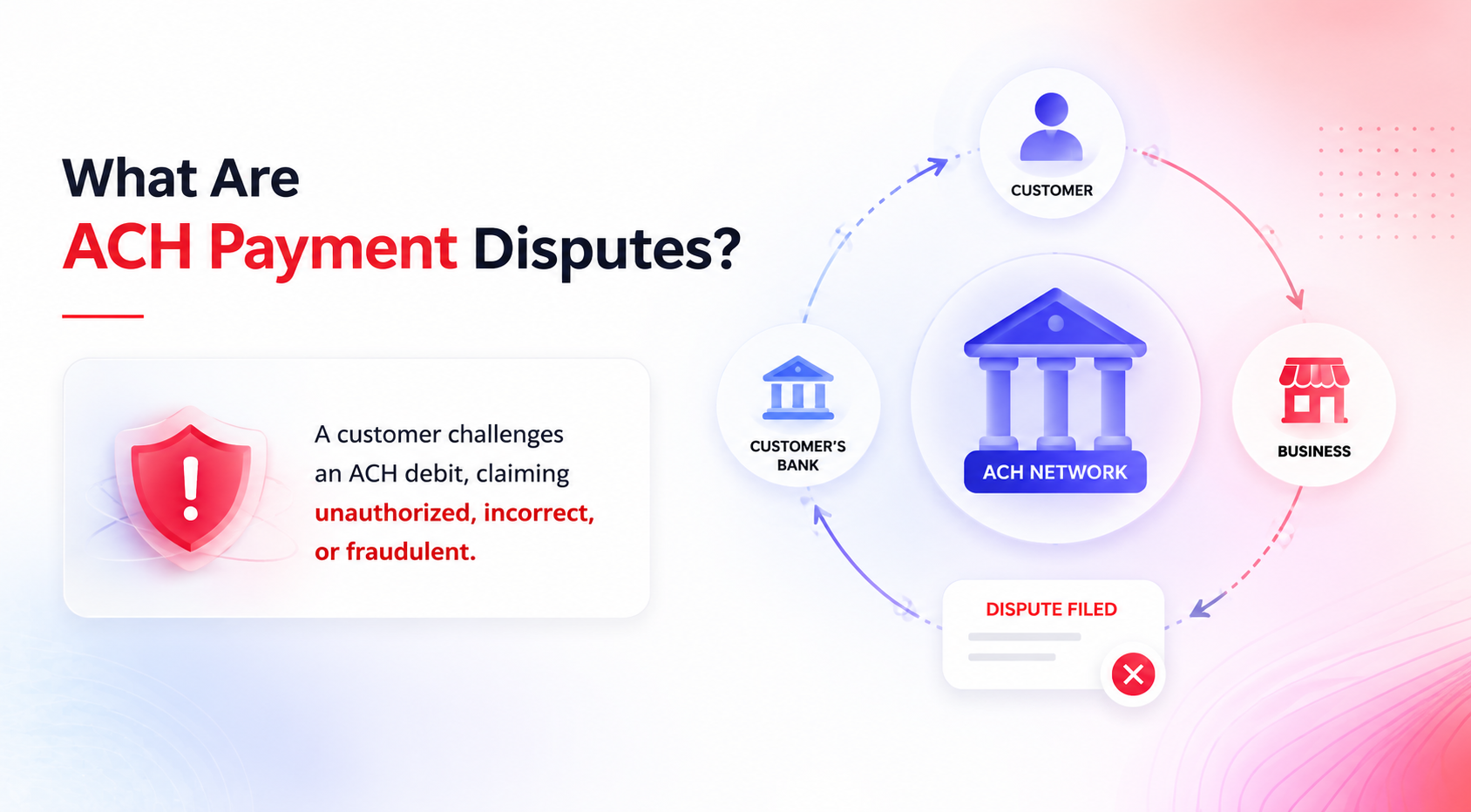
An ACH payment dispute occurs when a customer or account holder challenges a debit transaction that was processed through the Automated Clearing House (ACH) network. Unlike a simple return (where a payment fails due to insufficient funds or a closed account), a dispute involves an active claim that the transaction was unauthorized, incorrect, or fraudulent.
For businesses in logistics, retail, manufacturing, and other regulated industries, ACH disputes can freeze funds, trigger penalties, and damage your relationship with your payment processor. Understanding how disputes work—and how to prevent them—is one of the smartest investments you can make in your payment operations.
How ACH Payment Disputes Differ from ACH Returns
Before diving into dispute resolution strategies, it’s important to understand the difference between an ACH return and an ACH dispute.
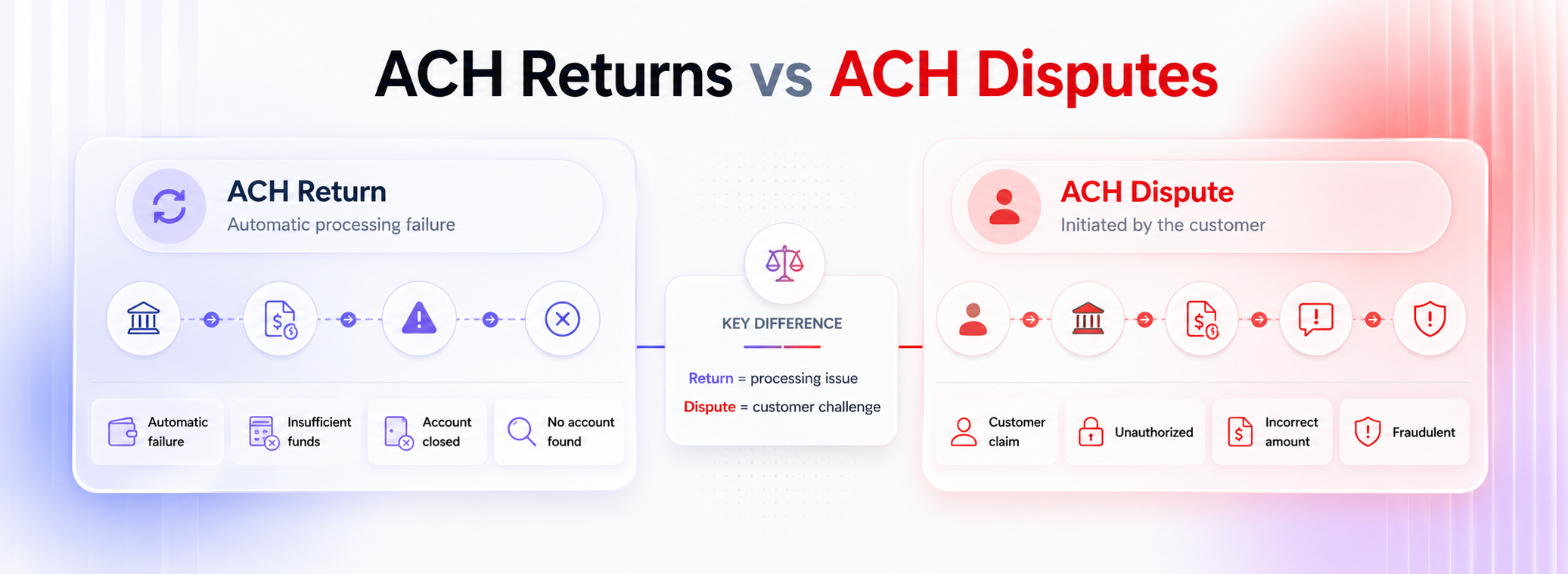
An ACH return happens automatically when a transaction cannot be processed. Common return codes include R01 (Insufficient Funds), R02 (Account Closed), and R03 (No Account Found). These are technical failures that typically require updating account information or retrying the transaction.
An ACH dispute, on the other hand, is initiated by the account holder—meaning your customer. The customer contacts their bank and claims the transaction was:
- Unauthorized — they never gave permission for the debit
- Incorrect — the amount charged does not match what was agreed upon
- Fraudulent — someone else used their account information without consent
When a dispute is filed, the receiving bank (your customer’s bank) initiates a chargeback process. Funds may be reversed, and your business is placed in the position of having to prove the transaction was legitimate.
Common Reasons ACH Disputes Arise
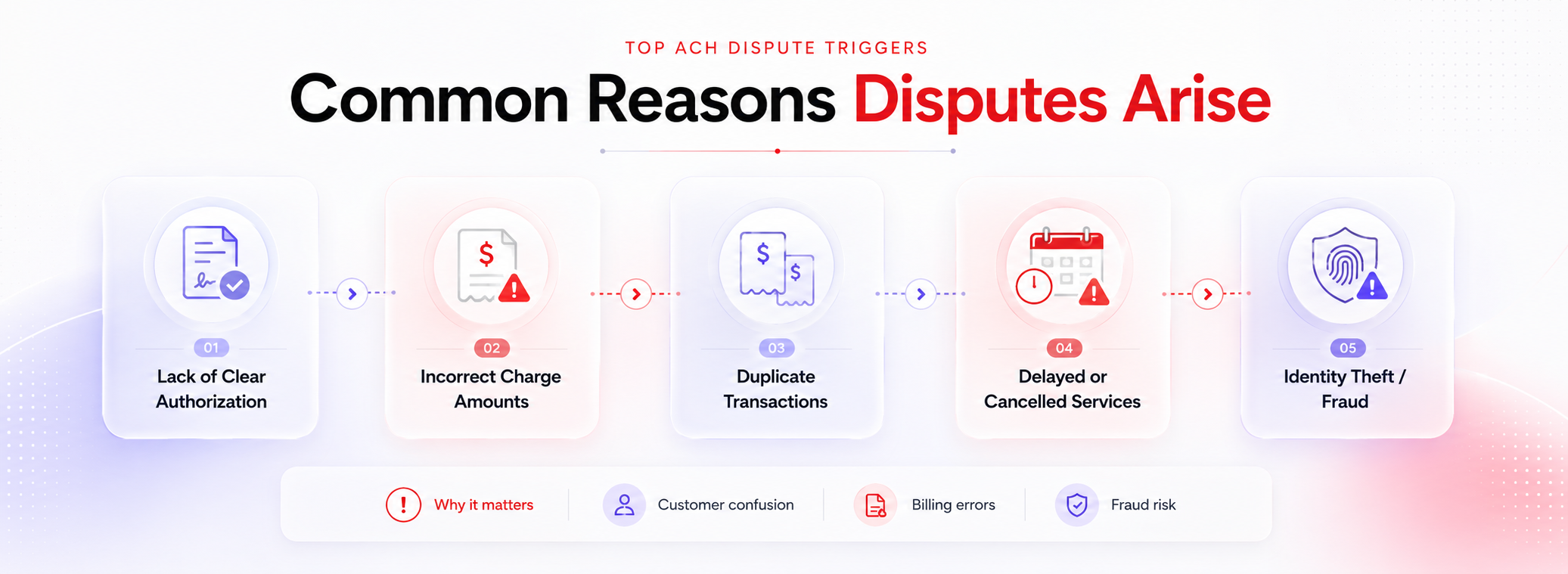
Understanding why disputes happen is the first step in preventing them. The most common triggers include:
1. Lack of Clear Authorization
This is the number one cause of ACH disputes. If your customer doesn’t clearly understand they’re authorizing a recurring debit—or if the authorization language is buried in fine print—they may later claim the charge was unauthorized. NACHA rules require businesses to obtain written or electronic authorization before debiting a customer’s account.
2. Incorrect Charge Amounts
Billing a customer for an amount that differs from what they agreed to is a fast track to a dispute. This can happen due to pricing errors, system bugs, or miscommunication between sales and billing teams.
3. Duplicate Transactions
Processing the same transaction twice—whether due to a technical glitch or a manual entry error—will almost always result in a dispute. Customers notice when they’re charged twice, and they have every right to challenge it.
4. Delayed or Cancelled Services
If a customer cancels a service and is still charged, or if they paid for a product or service they never received, a dispute is a likely outcome. Poor communication between your operations and billing teams is often the root cause.
5. Identity Theft and Account Fraud
In cases where a customer’s bank account information has been compromised, fraudulent ACH debits may appear on their statement. These disputes are not the merchant’s fault per se, but businesses with weak security practices are more vulnerable to being the conduit for fraud.
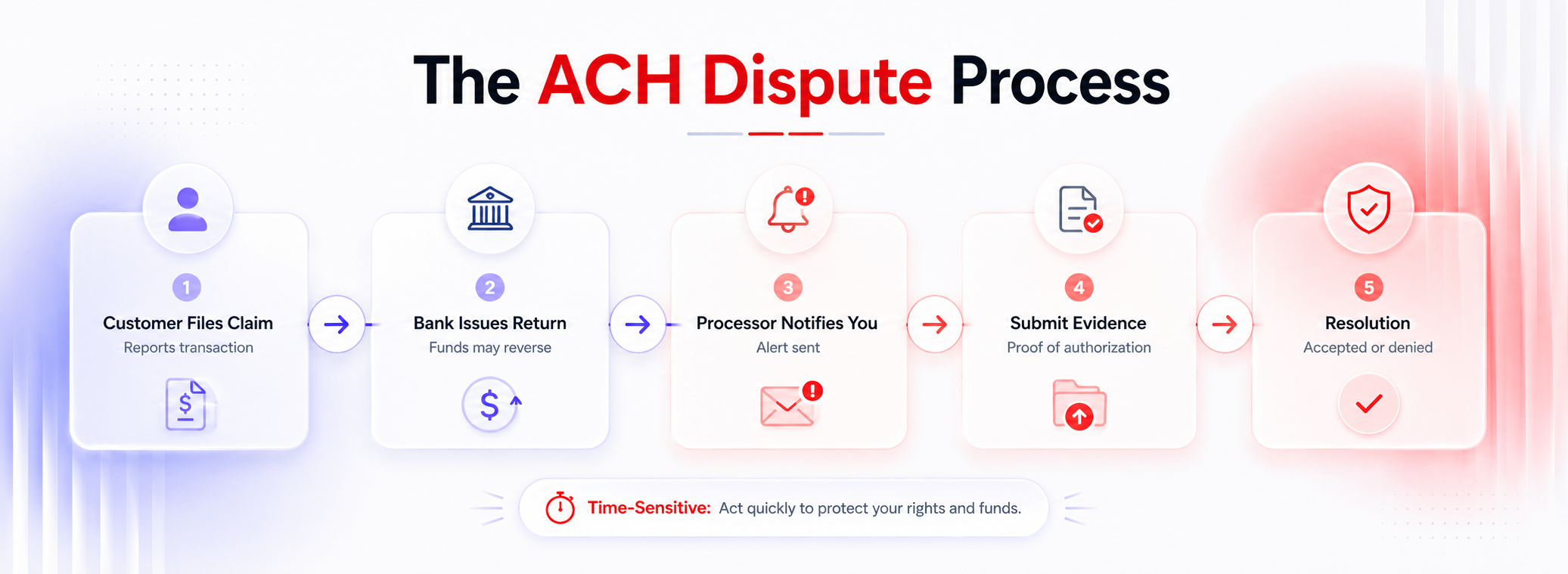
The ACH Dispute Process: What Happens Step by Step
When a customer files a dispute with their bank, here’s what typically unfolds:
Step 1 — Customer Files a Claim The account holder contacts their bank and reports the disputed transaction. For unauthorized consumer debits, NACHA rules allow customers to dispute a transaction up to 60 days after the settlement date.
Step 2 — Bank Issues a Return The customer’s bank initiates a return using specific ACH return codes such as R05 (Unauthorized Debit), R07 (Authorization Revoked by Customer), or R10 (Customer Advises Unauthorized). The funds are pulled back from the originating business.
Step 3 — Your Payment Processor Notifies You Your ACH processor or money movement platform notifies you of the dispute. You typically have a limited window—often just a few business days—to respond with documentation.
Step 4 — You Submit Evidence To contest the dispute, you must provide proof of authorization. This may include signed authorization forms, recorded verbal authorization, email confirmations, or transaction logs.
Step 5 — Resolution If your evidence is accepted, the funds are returned to your account. If not, the chargeback stands and you absorb the loss—along with any associated fees from your processor.
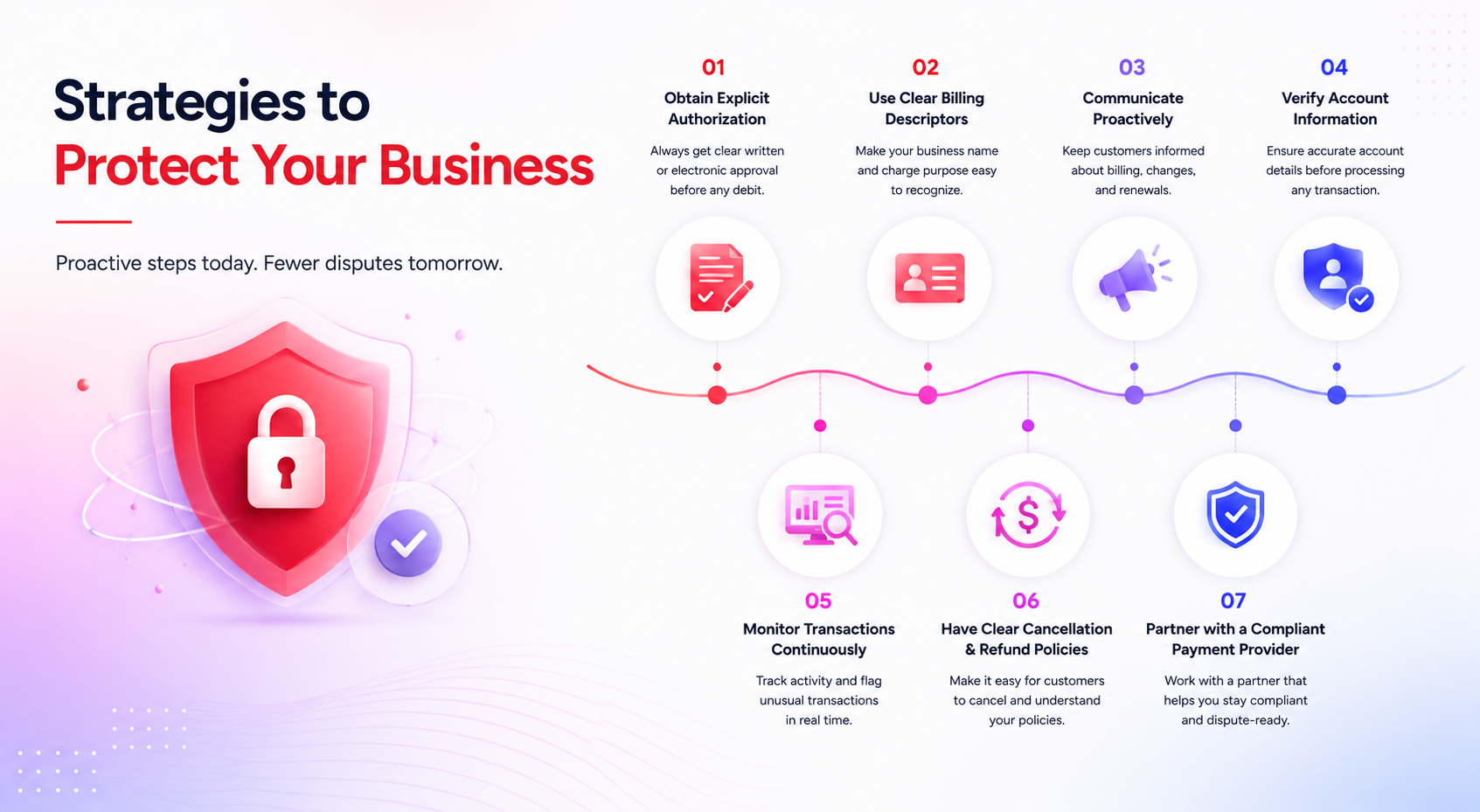
Strategies to Protect Your Business from ACH Disputes
The good news is that most ACH disputes are preventable. Here are the most effective strategies businesses can implement today:
1. Obtain and Store Explicit Authorization
Always get written or verifiable electronic authorization before processing an ACH debit. Your authorization should clearly state the amount, frequency, and account being debited. Store these authorizations securely for at least two years—or longer if your industry requires it.
2. Use Clear, Recognizable Billing Descriptors
When your business name appears on a customer’s bank statement, it should be immediately recognizable. If customers don’t recognize the name on their statement, they’re more likely to dispute the charge. Work with your payment processor to ensure your billing descriptor is clear and consistent.
3. Communicate Proactively with Customers
Send email or SMS confirmations whenever a scheduled ACH debit is about to occur. Give customers at least 3–7 days’ notice before charging their account. This simple step dramatically reduces disputes stemming from forgotten authorizations or surprise charges.
4. Implement Robust Account Verification
Before processing any ACH transaction, verify that the bank account and routing number are valid. Tools like micro-deposit verification and real-time account validation help ensure you’re debiting the right account—and that the account holder actually authorized the transaction.
5. Monitor Transaction Patterns for Anomalies
Use a payment platform with real-time monitoring capabilities to flag unusual transaction patterns. A sudden spike in transaction volume, multiple debits to the same account, or transactions outside normal business hours can all signal potential fraud before it escalates into a dispute.
6. Maintain Clear Cancellation and Refund Policies
Make it easy for customers to cancel recurring payments and ensure your team processes cancellations immediately. A customer who can’t easily cancel is far more likely to dispute charges with their bank instead.
7. Partner with a Compliant, Licensed Payment Platform
The infrastructure behind your ACH transactions matters enormously. Working with a licensed money transmitter that adheres to NACHA operating rules and state and federal regulations ensures that your transactions are processed with the proper safeguards in place—reducing your exposure to disputes and protecting your business in the event one arises.

What to Do When an ACH Dispute Happens
Even with the best prevention strategies, disputes can still occur. Here’s how to respond effectively:
Act Quickly — Most processors give you a narrow window to respond to a dispute notification. Set up alerts so you’re notified immediately and can begin gathering documentation right away.
Gather Your Evidence — Pull together all authorization records, transaction logs, customer communications, and any other documentation that proves the debit was legitimate and authorized.
Submit a Clear, Organized Response — Don’t overwhelm the reviewing bank with unnecessary paperwork. Present your evidence clearly and concisely, directly addressing the specific reason code behind the dispute.
Analyze the Root Cause — Win or lose, every dispute is a learning opportunity. Review why the dispute occurred and adjust your processes accordingly to prevent recurrence.
Track Your Dispute Rate — NACHA sets thresholds for acceptable return and dispute rates. Consistently exceeding these thresholds can put your ACH processing privileges at risk. Monitoring your dispute rate helps you stay compliant and identify systemic issues early.
Questions to Ask Your Payment Processor About Dispute Management
Not all payment processors are equally equipped to help you manage ACH disputes. Before choosing or evaluating your current processor, ask:
- Do you provide real-time dispute notifications? Every hour of delay in responding to a dispute is a risk. Your processor should notify you immediately when a dispute is filed.
- What documentation support do you offer? A strong processor will help you understand what evidence is needed for each dispute type and may even assist in organizing your response.
- How do you handle fraud detection? Ask specifically about tools for account verification, transaction monitoring, and identity validation that can prevent disputes before they start.
- Are you NACHA compliant? Your processor should operate under NACHA’s Operating Rules and demonstrate a clear understanding of compliance obligations for both originators and third-party senders.
- What is your track record with dispute resolution? Ask for data on dispute reversal rates. A processor with experience and strong compliance infrastructure will have better outcomes for merchants.

How Monarch Helps Businesses Manage ACH Transactions Securely
At Monarch, we built our financial infrastructure with compliance and security at the core—not as an afterthought. As a licensed money transmitter and certified Third Party Sender (TPS), Monarch operates under a strict regulatory framework that protects every transaction we facilitate.
Our platform provides businesses with:
- Bank-grade encryption and tokenized data to protect account information
- Real-time transaction monitoring to flag suspicious activity before it becomes a dispute
- Multi-state compliance management to ensure your ACH operations meet both state and federal requirements
- Seamless ACH processing with built-in safeguards designed to reduce return and dispute rates
- Full audit trails so you always have the documentation you need to defend a transaction
Whether you’re running a logistics operation, a retail business, or a technology company, Monarch’s platform gives you the infrastructure to move money with confidence—and the protection to handle disputes when they arise.
Final Thoughts on ACH Payment Disputes
ACH payment disputes are an unavoidable reality of doing business in the digital economy. But with the right processes, the right technology, and the right payment partner, they don’t have to be a major threat to your operations or your bottom line.
The key is preparation: obtain clear authorizations, communicate proactively with customers, monitor your transactions in real time, and respond to disputes quickly and thoroughly. Businesses that treat dispute management as a core operational function—not an afterthought—consistently outperform those that don’t.
And when you’re built on a compliant, secure payment infrastructure like Monarch’s, you start every transaction from a position of strength.
Ready to protect your business with a licensed, compliant payment platform? Schedule a Demo with Monarch and see how our infrastructure can simplify your ACH operations while keeping you protected.